


You go to bed tired.
You want to sleep.
You know you need sleep.
But somehow, your brain didn’t get the memo.
Maybe you lie there for an hour trying to shut your thoughts off. Maybe you fall asleep quickly but wake up at 2:00 or 3:00 AM and can’t get back to sleep. Maybe you sleep for seven or eight hours but wake up feeling like you barely slept at all.
And then there’s the morning.
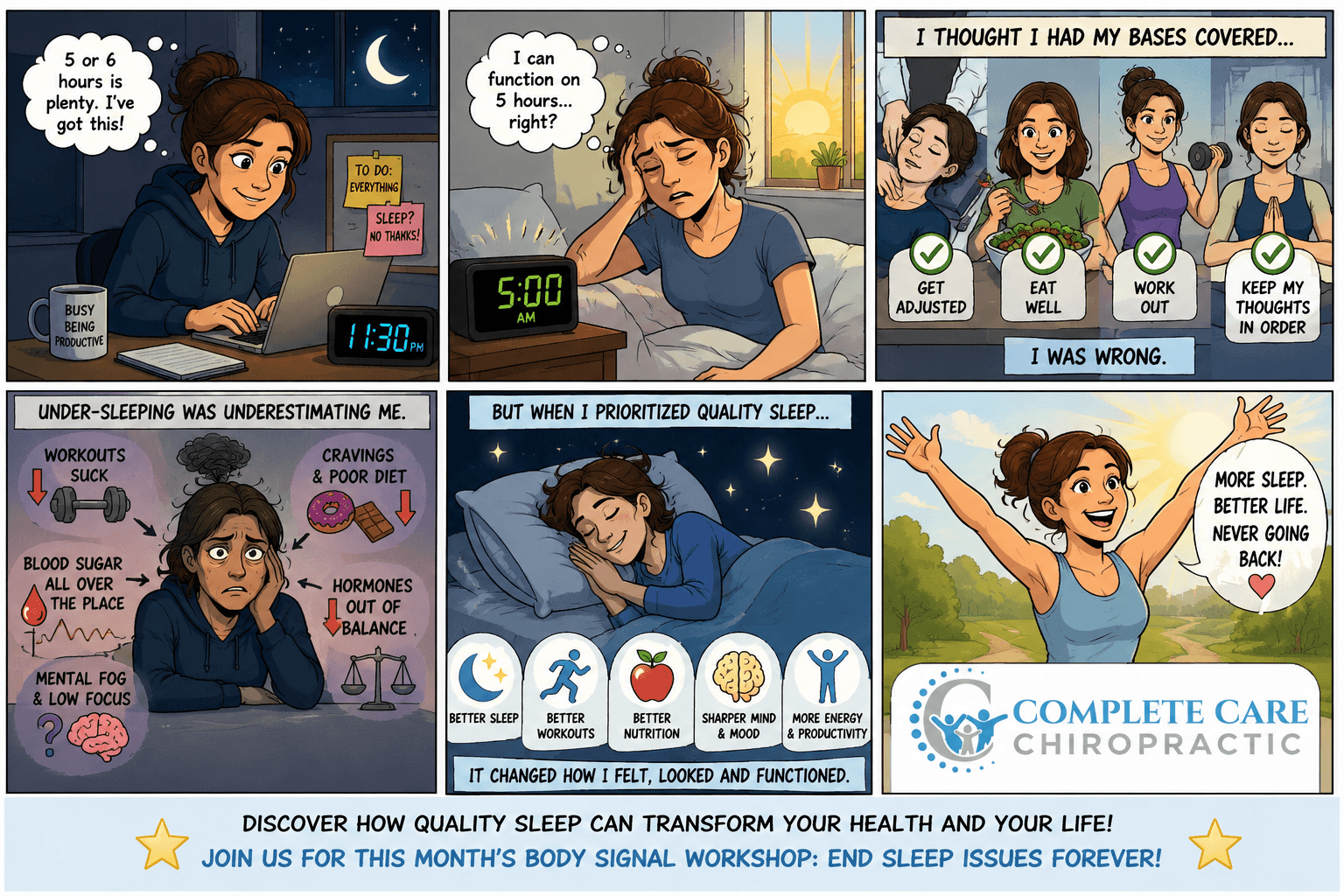
You’re dragging. Your brain feels foggy. Your body is stiff. Your workout doesn’t feel as good as it should. You’re reaching for another cup of coffee before you’ve even made it through breakfast.
If this sounds familiar, you’re certainly not alone. New data from the CDC shows that about 3 in 10 American adults are getting less than seven hours of sleep, while roughly 1 in 6 adults have trouble falling asleep and about 1 in 5 have trouble staying asleep.
Here’s something worth considering: Sometimes the answer isn’t simply “try harder to sleep” or even “Go to bed earlier.”
Your body may be giving you information about what it needs.
Sleep Is More Than Just Turning Off the Lights
Sleep is when your body gets an opportunity to recover from the demands of the day.
Your brain is processing information and consolidating memories. Your body is regulating important systems involved in metabolism, immune function, hormones, and recovery. Your muscles and other tissues get a chance to recover from the physical demands you’ve placed on them.
That’s why consistently short or poor-quality sleep can show up in places you might not expect.
Maybe our workouts suffer, maybe your appetite becomes harder to manage. Your mood and concentration can change.
You may become more sensitive to discomfort.
You may simply feel like you’re operating at 70% all day long. And while everyone is different, the current recommendation for most adults is to regularly get at least seven hours of sleep, with individual needs varying.
The question isn’t simply: “How many hours was I in bed?”
A better question is: “Did my body actually get a chance to recover?”
Your Nervous System Doesn’t Have an Off Switch
This is where things get particularly interesting. Your nervous system is constantly receiving information from your environment and from your body.
- Light. Sound. Temperature. Movement. Pain. Muscle tension. Joint movement. Stress. Thoughts.
Your nervous system is taking all of that information in and helping your body determine how to respond. During the day, you want your body to be able to respond. You need to be alert, move, work, exercise, take care of your family, etc.
But nighttime requires a different state. Your body needs to transition from doing to recovering.
That’s one reason a person can be physically exhausted but still feel like they can’t “shut down”; the body has not necessarily failed at sleeping, it may simply be receiving a lot of signals that say: Stay alert. Keep going. Something still needs your attention.
That is why creating the right conditions for sleep matters so much.
What Does Chiropractic Have to Do With Sleep?
A lot of people think of chiropractic as something you do when your back hurts, which isn’t necessarily false, but if you’re going for pain, you’remissing out on the real benefits. Your spine is part of the larger musculoskeletal and nervous system picture, acting as its guidian.
Your joints, muscles and connective tissues constantly send sensory information to your brain. When your spine and other joints aren’t moving well, when muscles remain tense, or when pain makes it difficult to find a comfortable position, those physical signals can become part of the problem.
Think about what happens when you try to sleep with a stiff neck; You roll onto your side, your shoulder hurts, you switch positions, now your low back doesn’t feel right, you move again, you finally find a position that works, only to wake up an hour later and start the process all over again.
It is difficult to get deeply restful sleep when your body can’t get comfortable.
This is one of the most practical ways chiropractic care can support better sleep.
By evaluating spinal movement, joint function, posture and musculoskeletal health, chiropractic care can help address some of the physical factors that may be making it harder to relax and stay comfortable at night.
Research supports spinal manipulation as an effective approach for certain types of spine-related pain, although the evidence does not mean chiropractic adjustments are a treatment or cure for insomnia itself.
Chiropractic isn’t a sleeping pill.
Instead, it’s one potential piece of a bigger strategy for helping your body move better, feel better and function better. And for someone whose sleep is being disrupted by discomfort or restlessness, that can be a very important piece.
But What If I’m Already Getting Adjusted?
This is a question we hear often. “I’m already getting adjusted. Why am I still having trouble sleeping?”
That’s actually a great question.
An adjustment is not meant to replace everything else your body needs. Think about it this way.
You can get regular dental cleanings, but that doesn’t mean you can stop brushing your teeth.
You can work with a personal trainer, but that doesn’t mean you can exercise for an hour and then sit on the couch for the other 23.
And you can receive chiropractic care, but your body still needs sleep, movement, nutrition, sunlight, recovery and appropriate stress management.
Chiropractic care supports the physical and neurological side of the equation, but you still have to give your body the building blocks it needs to recover.
That’s where things get really interesting.
Your Body Loves Signals
Your body has an internal clock called your circadian rhythm.
It helps coordinate when you’re alert, when you’re sleepy, and many other biological processes that follow roughly a 24-hour cycle.
And your body doesn’t read a clock on the wall to figure this out.
It watches your environment.
One of the strongest signals is light. Morning light tells your brain: It’s daytime. Wake up.
Darkness tells your body: It’s nighttime. Start preparing for sleep.
This is why something as simple as getting outside in the morning can be surprisingly helpful. It is also why spending the last hour of your day under bright lights, staring at your phone, answering work emails, and watching stimulating content isn’t necessarily the best way to tell your body it’s time to sleep.
Your body is constantly asking: What time is it? What should I be doing right now?
The more consistent the signals are, the easier it is for your body to establish a rhythm.
Start With Your Morning, Not Your Bedtime
One of the biggest mistakes people make when trying to improve sleep is focusing exclusively on what happens at night.
Instead, start in the morning.
Get up at roughly the same time each day, get outside, get some natural light, move your body, eat and hydrate appropriately, then let your body build up its natural sleep drive throughout the day.
By evening, begin changing the signals you’re sending; dim the lights, slow things down, put some distance between yourself and work, give your brain somewhere to put tomorrow’s to-do list, and create a predictable transition from busy to rest. This is much more effective than being on your phone at 10:58 PM and suddenly deciding: “Okay, I should probably sleep.”
Your Evening Routine Matters
Your body doesn’t always go from 100 miles per hour to completely relaxed in five minutes. Give it a transition;
Maybe it’s a warm shower, maybe it’s reading, maybe it’s gentle stretching, maybe it’s talking with your spouse, maybe it’s prayer or meditation, maybe you simply turn the lights down and stop consuming information.
The goal isn’t to create another complicated health routine that you have to “perform perfectly.”
It’s to create a predictable signal: The day is ending. You are safe. You can rest.
And if your mind is racing, try writing down the things you’re thinking about; tomorrow’s appointments, grocery lists, the email you need to send, the thing you’re worried about, etc.
Get it out of your head and onto paper. You don’t have to solve everything at 10:30 at night.
Your Bedroom Should Help You Sleep
Your bedroom doesn’t need to look like a luxury hotel, it does need to be conducive to sleep.That can look like;
Cool.
Dark.
Quiet.
Comfortable.
And preferably boring.
Your brain should associate your bed with sleep, not scrolling, working, watching stressful news or answering emails. If you’re waking up because your neck or back hurts but you’re already getting adjusted and know your spine is in alignment, your sleeping position and pillow may also deserve some attention. There isn’t one universally perfect sleeping position for everyone. The goal is to find a position that allows your spine and joints to remain supported and comfortable rather than forcing your body into a position that creates tension for hours at a time. If you’re consistently waking with neck or back stiffness, that’s something worth discussing with your chiropractor.
 What You Put Into Your Body Matters, Too
Sleep doesn’t exist in isolation from the rest of your health. If you’re living on caffeine all day, eating heavy meals late at night, drinking alcohol to help yourself fall asleep, barely moving your body and then wondering why you don’t feel rested, your body isn’t necessarily confused. It’s responding to the signals you’re giving it. Caffeine deserves particular attention. If you’re having trouble falling asleep or staying asleep, experiment with moving your caffeine earlier in the day.
Alcohol is another one. It may make you feel sleepy initially, but it can interfere with normal sleep patterns and isn’t a reliable strategy for restorative sleep.
Regular physical activity is helpful, too. Your body needs movement during the day, and exercise can support sleep quality while also supporting overall physical health.
You don’t need a perfect diet or a perfect workout program.
You need consistent basics; Real food, regular movement, adequate hydration, enough sleep, time outside, and chiropractic adjustments to create a nervous system that gets opportunity to adapt to the constant demands of modern life.
The Bigger Picture: Your Body Needs the Right Conditions to Recover
This is ultimately what we want people to understand. Better sleep isn’t about finding one magic trick, but rather creating an environment where your body can do what it was designed to do. Your spine needs to move. Your body needs physical activity. Your nervous system needs periods of lower stimulation. Your brain needs appropriate light and darkness cues. Your body needs quality nutrition. Your mind needs opportunities to slow down. And your body needs enough time to actually sleep.
When your spine and joints move well and your body is more comfortable, you’re removing one potential common barrier to restful sleep. When you combine that with healthy movement, good nutrition, appropriate stress management, consistent sleep timing and a supportive sleep environment, you’re giving your body much more of what it needs to recover. That’s the approach we believe in at Complete Care Chiropractic.
We’re not interested in pretending that one adjustment fixes everything. We’re interested in helping you understand your body and giving it the support it needs to function at its best.

Having Trouble Sleeping? Come Learn With Us.
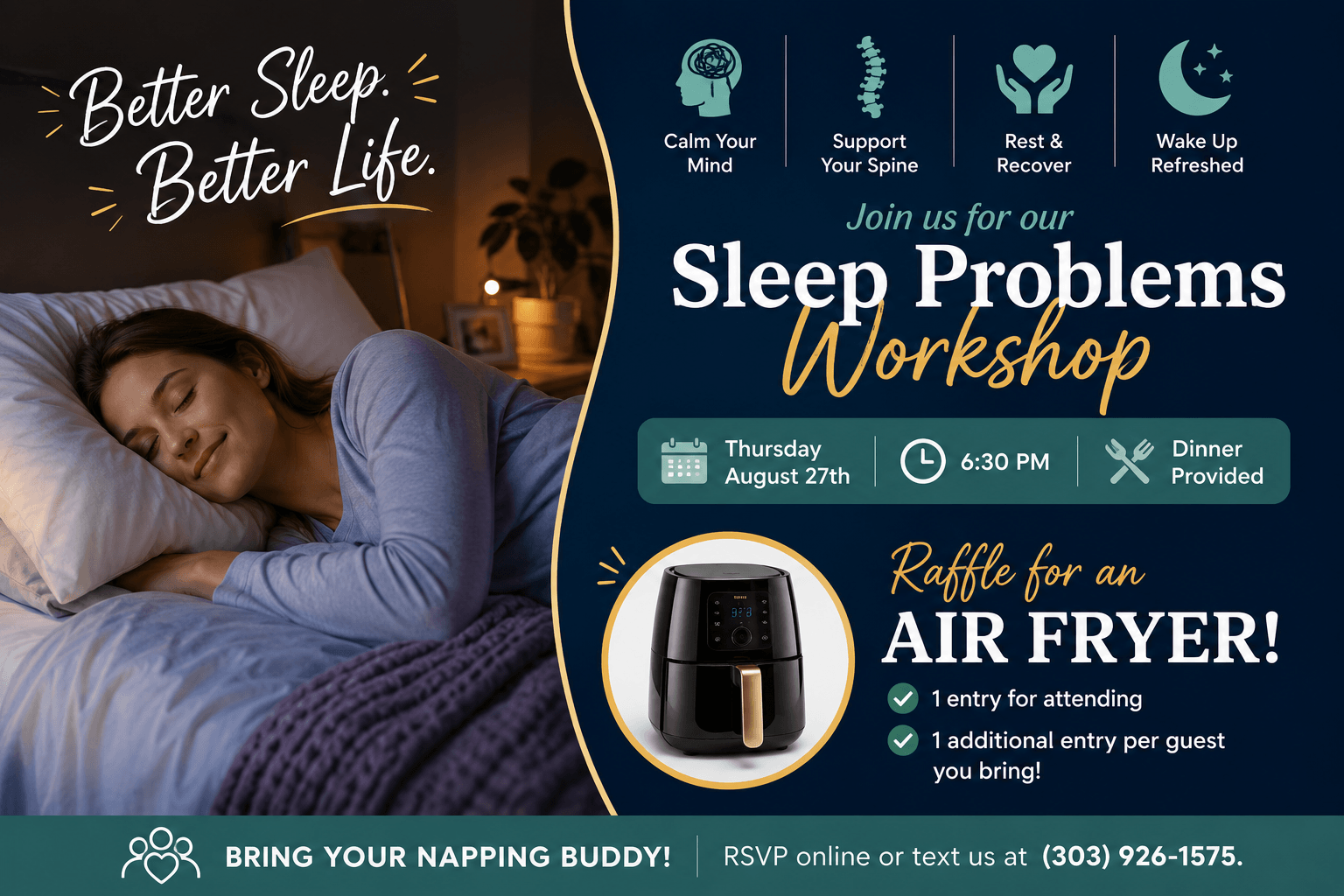
We’re talking about all of this and more at our upcoming Body Signal Workshop: Sleep Problems.
Thursday, August 27 at 6:30 PM
Complete Care Chiropractic; 1280 Centaur Village Dr. STE 8
Lafayette, CO, 80026
Dinner will be provided, and the workshop is completely FREE and open to everyone. So don’t come alone!
Bring your napping buddy. Bring your spouse, friend, family member or anyone else who keeps telling you, “I just can’t seem to sleep!”
We’ll talk about what your body needs for quality sleep, why you may be struggling to fall asleep or stay asleep, and how the nervous system, spinal health, daily habits and recovery all fit into the bigger picture.
And because we like to have a little fun with our workshops, current Complete Care Chiropractic patients who attend will be entered into our Air Fryer Raffle!
RSVP yourself and your napping buddy today.
[RSVP FOR THE FREE SLEEP PROBLEMS WORKSHOP →] https://www.facebook.com/share/19LksRr2ir/
Sources & Further Reading
Centers for Disease Control and Prevention / National Center for Health Statistics — Current U.S. data on short sleep duration and sleep difficulties. CDC: Short Sleep Duration and Sleep Difficulties Among Adults
American Academy of Sleep Medicine — Current recommendations and clinical guidance regarding chronic insomnia and CBT-I. AASM: Cognitive Behavioral Therapy for Insomnia
American Academy of Sleep Medicine Clinical Practice Guideline — Evidence supporting CBT-I as a first-line behavioral treatment for chronic insomnia. AASM Clinical Practice Guideline for Chronic Insomnia
American College of Physicians — Evidence-based guideline recommending CBT-I as initial treatment for chronic insomnia. American College of Physicians: Chronic Insomnia Guideline
Journal of Orthopaedic & Sports Physical Therapy / PubMed — Recent systematic review and network meta-analysis examining spinal manipulation for adults with spine pain. PubMed: Spinal Manipulative Therapy and Spinal Pain
Scientific Reports / PubMed — Systematic review examining whether the location of spinal manipulation affects outcomes for spinal pain. PubMed: Spinal Manipulation and Spinal Pain